

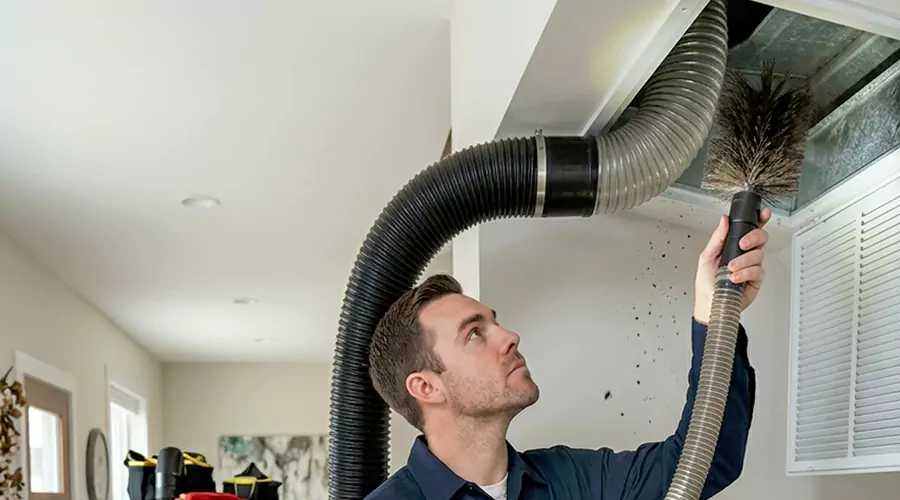
Removing mold from air ducts requires identifying the moisture source and determining whether the affected duct material can be cleaned or must be replaced. Bare metal ducts may be cleaned when contamination is confirmed, but wet or moldy fiberglass insulation generally requires replacement. The mold problem is likely to return unless the underlying moisture condition is corrected.
Mold can develop inside HVAC systems when condensation or water leaks keep surfaces damp. Dust and other organic deposits provide nutrients that allow fungal growth under suitable conditions. If contamination extends into the ductwork, ordinary household vent cleaning may not reach the affected materials and can disturb particles inside the system.
The correct removal method depends on the extent of contamination and the construction of the ducts. A small spot on an exterior grille is different from mold growing inside insulated ductwork. Understanding these differences helps homeowners avoid ineffective cleaning methods and unnecessary replacement expenses.
Can Mold Be Completely Removed From Air Ducts?
Mold contamination can often be removed from sound nonporous duct surfaces when the moisture source has been corrected. However, porous materials such as fiberglass duct insulation are difficult to restore once mold develops within them. Successful remediation involves removing affected material and preventing the damp conditions that supported growth.
Mold spores are naturally present in indoor and outdoor air, so removing every spore from a home is not a realistic goal. The purpose of remediation is to eliminate established growth and restore dry conditions. Without moisture, ordinary background spores cannot continue growing on building surfaces.
Bare sheet metal ducts offer a relatively smooth surface that can sometimes be cleaned effectively. Fiberglass duct board and internally lined sections behave differently because moisture can enter the material. When contamination develops within those fibers, replacing the affected section is generally more appropriate than applying a surface treatment.
What Should You Do Before Removing Mold From Air Ducts?
Before cleaning suspected mold, determine whether the HVAC system contains actual contamination and identify where the moisture is coming from. Cleaning without this assessment can spread material or leave the original problem unresolved. The first response should focus on reducing disturbance and documenting visible conditions.
Stop Operating a Suspected Contaminated HVAC System
If you know or have credible reason to suspect that the HVAC system itself contains mold, stop operating it until the condition has been assessed. Running the blower can move particles from contaminated components into other areas of the building. This precaution is particularly important when growth is suspected near the return intake or inside the air handler.
Avoid switching the fan to continuous operation in an attempt to dry or ventilate contaminated ducts. Moving air through suspected growth is not the same as safely removing moisture. The condition of the affected system should be evaluated before normal operation resumes.
Identify the Moisture Source
Mold remediation will not remain effective if water continues entering the system. Condensation around the evaporator coil and clogged condensate drains are common sources of moisture. Leaking building components can also wet duct insulation or allow water to enter concealed sections.
Look for evidence of standing water near accessible drainage components and record any recent leaks. Persistent condensation around vent openings may suggest high indoor humidity or inadequate insulation. Identifying the source helps determine which repair is needed before contaminated material is removed.
Determine the Type of Duct Material
HVAC systems can contain bare metal ducts and insulated flexible sections. Some systems also use fiberglass duct board or metal ducts with insulation attached to the interior surface. These materials cannot all be cleaned using the same method.
The difference matters because porous insulation can retain contamination beneath its visible surface. Aggressive brushing may damage the fibers without removing growth from the material. Confirming duct construction prevents inappropriate cleaning methods from being used on sensitive sections.
How Is Mold Removed From Air Ducts?
The removal process begins with assessing the contamination and correcting the moisture source. Confirmed mold on suitable hard surfaces may be removed through controlled physical cleaning, while contaminated porous insulation is generally replaced. The exact method depends on the duct material and how much of the system is affected.
Step 1. Confirm the Affected Areas
The first step is determining where visible contamination exists and whether it extends beyond an accessible opening. A dark stain on a vent cover does not automatically prove that mold is present inside the entire duct system. Dust and other deposits can resemble fungal growth, so the condition should be evaluated carefully.
An assessment should identify affected components and document visible contamination. The evaporator coil area and nearby duct sections may deserve attention when moisture problems are present. Laboratory identification may be useful in uncertain cases, but extensive testing is not automatically necessary when growth and the moisture source are already clear.
Step 2. Correct the Water Problem
The moisture source must be corrected before remediation can be considered successful. A clogged condensate drain may need to be cleared, while a leaking roof or plumbing connection requires an appropriate repair. Damaged duct insulation may also need attention when it allows repeated condensation to develop.
Cleaning contaminated surfaces while leaving a drain overflowing creates conditions for the problem to return. Similarly, replacing wet insulation without correcting a nearby leak can lead to renewed damage. Moisture control is therefore part of the removal process rather than an optional maintenance step.
Step 3. Control the Spread of Contaminated Material
Mold removal should prevent disturbed particles from spreading into occupied rooms. This becomes more important when substantial contamination is present inside concealed HVAC components. Brushing dry material without controlling debris can release particles into the surrounding air.
Remediation methods for significant contamination may involve isolating affected sections and using suitable collection equipment. The precise controls depend on the extent of the problem and the building's layout. Household fans and ordinary vacuum cleaners are not substitutes for an appropriate containment and collection method.
Step 4. Remove Contamination From Suitable Hard Surfaces
Confirmed mold on sound bare metal duct surfaces may be removed through appropriate physical cleaning. The objective is to remove growth and associated deposits rather than simply change their appearance. Any cleaning method must be compatible with the duct material and prevent debris from entering occupied areas.
A smooth metal surface is generally easier to clean than porous insulation because contamination does not penetrate it in the same way. However, the entire affected section must be accessible for the cleaning to be meaningful. Removing only the visible material near a register may leave contamination elsewhere in the system.
Step 5. Replace Contaminated Porous Materials
Wet or moldy fiberglass duct material generally cannot be cleaned effectively. Mold can develop within the spaces between fibers, making complete removal difficult without damaging the insulation. Applying cleaning chemicals to the visible surface does not reliably restore the material.
Contaminated internal duct insulation should therefore be removed and replaced where necessary. The same principle applies to severely affected fiberglass duct board and flexible duct sections that cannot be adequately restored. The replacement should occur after the moisture source has been corrected to prevent renewed contamination.
Step 6. Address Other Affected HVAC Components
Contamination may involve components outside the duct passages. The cooling coil area and air handler cabinet can develop moisture-related problems, particularly when drainage is poor. Cleaning only the ducts may leave affected equipment surfaces untreated.
A complete assessment should identify whether the condensate pan contains standing water or whether nearby materials remain damp. The appropriate response depends on the construction of each component. Restoring proper drainage is particularly important because cooling equipment produces condensate during normal operation.
Step 7. Verify That the Moisture Problem Is Resolved
The final stage involves confirming that affected surfaces are dry and that the original water problem has been corrected. Visible growth should no longer remain on cleaned surfaces, and contaminated materials scheduled for replacement should be removed. A successful cleanup should also address conditions that could cause growth to return.
Verification may include visual inspection and moisture measurements. Specialized sampling is not automatically necessary for every project, particularly when the contamination was limited and the cleanup can be evaluated directly. The goal is to confirm suitable conditions for returning the HVAC system to normal use.
Can Different Duct Materials Be Cleaned or Must They Be Replaced?
The duct material is one of the most important factors in deciding how mold should be removed. Nonporous metal surfaces are generally easier to restore because they can be cleaned without water entering the material itself. Porous duct insulation requires more caution because contamination can extend beneath the visible surface.
| Duct Material | Cleaning Consideration | Typical Response |
|---|---|---|
| Bare sheet metal | Smooth nonporous surface | Cleaning may be possible |
| Internally insulated metal | Porous liner can retain growth | Replace affected insulation |
| Fiberglass duct board | Contamination can enter the fibers | Replace moldy material |
| Flexible insulated duct | Liner and insulation may be difficult to restore | Replace affected sections when necessary |
| Damaged duct with persistent water exposure | Structural and moisture problems | Repair or replace damaged material |
A duct system can contain several of these materials in different locations. For example, a metal supply trunk may connect to flexible branches leading toward individual rooms. The cleaning method should reflect each section's construction rather than assume that one approach is suitable throughout the system.
A common mistake is treating all visible discoloration with the same chemical product. Even when a treatment is appropriate for a particular hard surface, it may be unsuitable for an insulated duct. Material identification should come before choosing a remediation technique.
Can You Remove Mold From Air Ducts Yourself?
Household mold cleanup guidance does not automatically apply to contamination inside an HVAC system. Small isolated patches on ordinary hard household surfaces can sometimes be cleaned safely, but ductwork presents additional concerns involving concealed materials and possible particle distribution. The appropriate response depends on whether contamination is limited to an exterior surface.
For general household mold, EPA guidance indicates that areas smaller than approximately 10 square feet can often be handled by homeowners under suitable conditions. However, this threshold should not be interpreted as permission to clean ten square feet of mold inside the HVAC system. Contamination involving ducts or air handling equipment requires a separate assessment.
A homeowner can complete limited preliminary tasks without disturbing suspected growth:
- Switch off the HVAC system when internal contamination is known or credibly suspected.
- Photograph visible deposits without scraping or brushing them.
- Look for water stains around accessible vents and nearby walls.
- Measure indoor humidity with a hygrometer.
- Record any recent leaks or recurring condensation.
- Identify which rooms or openings appear affected.
An isolated small patch on a removable hard exterior grille may sometimes be cleaned with detergent and water when there is no evidence of internal HVAC contamination. The surface must be dried completely, and the moisture source must be corrected. People with significant mold-related health concerns should avoid undertaking cleanup themselves.
Avoid removing internal duct insulation or cutting into concealed ducts as a household cleaning project. These actions can damage materials and create additional opportunities for contamination to spread.
Does Bleach Remove Mold From Air Ducts?
Bleach is not recommended as a routine solution for removing mold from ductwork. It may change the appearance of some surface growth, but spraying it inside the HVAC system does not reliably remove contamination. The treatment may also introduce moisture and chemical residues into areas that are difficult to rinse or dry.
Mold remediation requires physical removal of contaminated material where appropriate. Killing visible growth without removing it is not the same as cleaning the surface. Dead mold particles may still cause allergic reactions in susceptible people, which is another reason chemical treatment alone is insufficient.
Bleach must never be mixed with ammonia-based cleaning products because the reaction can produce toxic fumes. Household chemical mixtures should not be introduced into ventilation systems. The safest approach is to identify the material and correct the moisture problem before selecting a cleaning procedure.
Does Fogging Air Ducts Remove Mold?
Fogging introduces a fine mist of a chemical treatment into the duct system. Some services promote this method as a way to address microbial contamination without physically reaching every affected surface. However, fogging does not automatically remove established growth or restore contaminated insulation.
The main limitation is that chemical treatment does not necessarily remove the material supporting mold growth. Dust and contaminated insulation can remain inside the duct even if a product affects some microorganisms. When moisture is still present, conditions that supported the original contamination may continue.
Chemical biocides also have restrictions based on their approved uses. Products intended for hard nonporous surfaces are not automatically suitable for fiberglass-lined ductwork. Applying an inappropriate treatment may create additional concerns without resolving the problem.
Fogging should therefore not be treated as a replacement for moisture correction and actual contamination removal. A proposal based mainly on spraying chemicals deserves careful scrutiny, particularly when the affected duct material has not been identified.
What Are the Signs That Mold Remediation Is Not Working?
Mold remediation may be incomplete when visible growth returns or moisture remains present after cleanup. Recurring symptoms often indicate that the original source was not fully corrected. However, a musty odor or dark stain alone does not prove that the completed work has failed.
Watch for these warning signs:
- Visible growth returns on previously cleaned surfaces.
- Condensation continues appearing in the same duct area.
- Water remains standing in the condensate drain pan.
- Wet insulation was left in place after remediation.
- A recurring leak continues affecting the ductwork.
- Suspected contamination remains visible on nearby HVAC components.
- The same damp odor returns during system operation.
- Damaged duct connections remain unrepaired.
- Moisture readings stay elevated in affected building materials.
- Cleaning records do not identify the source of the original problem.
The most useful verification focuses on dryness and the condition of affected materials. A duct may appear cleaner while still experiencing condensation problems. Similarly, a newly installed insulated section can become contaminated again if water continues entering through the same opening.
How Much Does Air Duct Mold Removal Cost in 2026?
The cost of removing mold from air ducts depends on the extent of contamination and whether materials need replacement. Cleaning sound metal ducts is different from removing moldy fiberglass insulation or addressing contamination throughout an HVAC system. Concealed ducts can also require additional work to reach the affected sections.
The following are broad U.S. cost estimates reported for 2026. They describe different project scopes rather than fixed prices for individual vents.
| Mold Problem | Typical Work | Estimated 2026 Cost |
|---|---|---|
| Small isolated hard surface outside the HVAC interior | Household surface cleaning | Basic cleaning supplies |
| Localized duct mold contamination | Duct remediation | $600 to $2,000 for some projects |
| Mold affecting HVAC equipment and ducts | Extensive HVAC remediation | $2,000 to $10,000 |
| Wet or moldy fiberglass insulation | Remove and replace affected sections | Requires a section-specific estimate |
| Damaged duct contributing to moisture | Duct repair | $200 to $1,000 for many repair projects |
These estimates should not be added together automatically because some remediation projects already include related cleaning or removal work. The final scope depends on how much ductwork is affected and whether replacement materials are necessary.
A limited area of sound sheet metal may require less work than contamination affecting multiple internally insulated branches. The condition of the air handler also matters because duct cleaning alone cannot resolve contamination in other parts of the HVAC system.
When Should You Call a Professional for Duct Mold Removal?
Professional assessment is appropriate when mold is suspected inside the duct system or when contaminated materials extend beyond an accessible exterior grille. Extensive water damage and wet internal insulation also require careful evaluation. These conditions involve components that are difficult to inspect and cannot always be restored through ordinary household cleaning.
What Should a Proper Inspection Include?
A qualified assessment should identify where contamination is present and determine which materials are affected. The inspection should also investigate condensation and drainage problems that may have caused the growth. Visible evidence is important because ordinary dust can be mistaken for mold.
The proposed work should clearly distinguish cleanable metal surfaces from materials that require replacement. If only one section is affected, the reason for treating the entire system should be explained. The objective is to match the remediation method to the documented condition rather than apply the same procedure everywhere.
What Equipment May Be Used During Remediation?
Controlled removal may involve specialized vacuum equipment and methods designed to limit the spread of contaminated particles. Appropriate containment can be particularly important when contaminated materials must be removed from concealed spaces. Cleaning methods should be compatible with the duct material and should not damage insulation or internal surfaces.
The exact process depends on the size and location of the affected area. A sound metal duct may require a different approach from an insulated flexible branch. Chemical treatment should not be substituted for removal of material that cannot be effectively cleaned.
How Can You Evaluate the Finished Work?
The completed work should address both contamination and moisture. Request documentation showing which components were cleaned or replaced and what was done to correct the water source. The affected areas should be visibly free of growth and suitable for normal system operation.
A useful completion check also considers whether drain pans are functioning and previously damp materials are dry. Additional testing may be appropriate in some situations, but it is not automatically necessary for every small remediation project. The required verification should reflect the actual conditions and the scope of work.
How Can You Prevent Mold From Returning After Removal?
Preventing mold from returning requires maintaining dry conditions inside the HVAC system. Even a thorough cleanup may fail if condensation or water intrusion continues. Proper filtration helps reduce accumulated particles, but moisture control remains the main preventive measure.
Maintain the Condensate Drain System
Air conditioning equipment produces condensate during normal cooling operation, and that water must drain away properly. During maintenance, check for signs of standing water or overflow near accessible drainage components. Repeated drainage problems should be corrected before they damage surrounding insulation or building materials. Keeping the drainage system functional reduces the chance of persistent dampness near the cooling equipment.
Control Indoor Humidity
Monitor indoor relative humidity and aim for approximately 30% to 50% when practical. Bathrooms and laundry areas can introduce additional moisture that should be removed through suitable ventilation. If humidity remains consistently elevated, identify why the building is retaining moisture rather than relying only on surface cleaning. Lower humidity reduces the likelihood that cold HVAC surfaces will develop recurring condensation.
Maintain Duct Insulation and Connections
Inspect accessible ductwork for damaged insulation or separated joints during routine maintenance. Supply ducts in unconditioned spaces need suitable insulation to reduce condensation when cold air moves through them. Gaps around connections can expose cold surfaces to humid air and create repeated moisture problems. Correcting these conditions helps protect both duct materials and surrounding building surfaces.
Replace HVAC Filters as Recommended
Check air filters regularly and replace them according to the manufacturer's maintenance schedule. Proper filtration reduces the amount of airborne material collecting on downstream equipment. Make sure the filter fits securely because gaps around the frame can allow air to bypass the filtration material. A clean filter does not prevent mold by itself, but it supports normal HVAC maintenance.
Respond Quickly to Water Damage
Repair roof and plumbing leaks promptly when they affect spaces containing ductwork. Dry damp materials within 24 to 48 hours when possible to reduce the chance of mold development. If insulation becomes saturated or shows signs of contamination, evaluate whether replacement is necessary. Leaving concealed materials wet can allow the problem to continue after visible surfaces appear dry.
Conclusion
Removing mold from air ducts requires more than spraying cleaning products into the ventilation system. The process depends on correcting moisture and determining which materials can be restored. Sound metal ducts may be cleaned, while contaminated fiberglass often needs replacement. Extensive growth should receive professional assessment before remediation begins. This week, check accessible HVAC drainage areas and investigate any recurring condensation or water damage.